
Rolling Sculptures: The 10 Most Visually Arresting Supercars in Automotive History
For over a decade, I’ve immersed myself in the intricate world of automotive design, witnessing firsthand the evolution of the most beautiful supercars from mere machines to rolling works of art. The question of what truly defines automotive beauty is a perpetual debate, often touching on the elusive principles of the Golden Ratio, the ruthless efficiency of aerodynamic engineering, or perhaps something more profound – a sculpted line that evokes primal emotion, a stance that hints at untamed power, or a visage that speaks to the soul.
Historically, the automobile has undergone a remarkable transformation, transcending its utilitarian origins to become a profound medium for artistic expression by the world’s most visionary industrial designers. While the core purpose of a supercar remains an unyielding pursuit of speed – measured in lap times, sheer horsepower, and the visceral force of G-forces – a distinguished echelon of vehicles exists where the stopwatch gracefully yields to the sketchpad. These are machines that possess an inherent dynamism, radiating speed even at a standstill; cars not merely to be driven, but to be profoundly admired.
The design philosophies have shifted dramatically. In the latter half of the 20th century, beauty was often organic, painstakingly hand-beaten from aluminum by the masterful artisans of Italy. Today, in the 2020s, beauty is increasingly a product of computational fluid dynamics and digital sculpting, meticulously carved by the wind in virtual wind tunnels. Yet, across these distinct eras, certain quintessential silhouettes have proven to be enduringly timeless.
This curated list eschews rankings based on raw performance metrics or exorbitant price tags. Instead, it focuses on a singular criterion: visual impact. These are the most beautiful supercars that have left an indelible mark on automotive history through their sheer aesthetic brilliance.
The Pinnacle of Automotive Aesthetics: Top 10 Most Beautiful Supercars Ever Created
Lamborghini Miura P400 SV (1971): The Genesis of Allure
Designer: Marcello Gandini (Bertone)
Era: The Swinging Sixties
The Essence: The captivating gaze of a celestial being.
If one were to consult a lexicon for the term “supercar,” a visual representation of the Lamborghini Miura would likely be its prime illustration. Prior to the Miura, high-performance vehicles predominantly featured front-mounted engines, akin to the Ferrari Daytona. The Miura fundamentally redefined the paradigm by ingeniously placing its V12 engine transversely behind the driver, resulting in a profile that was remarkably low, exceptionally wide, and exuded an almost illicit sensuality.
Design Language: Marcello Gandini, a mere 22 years of age, penned the Miura, a testament to youthful audacity and a disregard for conventional automotive design. The car’s form possesses an almost biological fluidity. The sweeping front fenders rise with the voluptuous grace of a reclining feminine form, while the doors, when opened, unfurl like the horns of a charging bull, a subtle nod to Lamborghini’s iconic emblem. Its most defining features include the distinctive “eyelashes” framing the headlights on early iterations and the intricate hexagonal honeycomb grille adorning the rear. It defies the notion of being a mere machine; it feels more akin to a creature born from an primordial egg.
Why It’s Beautiful: The Miura embodies a delicate fragility often absent in contemporary supercars. Its slender pillars, elegantly understated chrome bumpers, and low-slung nose collectively contribute to an aura of exquisite elegance. While undeniably aggressive, its demeanor is more commanding than overtly hostile. It is, without hyperbole, arguably the most significant piece of industrial design to emerge from the 20th century, a true benchmark for Lamborghini supercar design.
Alfa Romeo 33 Stradale (1967): The Elusive Masterpiece
Designer: Franco Scaglione
Era: The Golden Age of Racing
The Essence: The pure, unadulterated distillation of Italian passion.
While the Miura commands widespread recognition, the Alfa Romeo 33 Stradale exists in a realm of near-mythical status. With only 18 examples ever produced, it is consistently lauded by automotive designers as the zenith of automotive beauty. It is astonishingly compact, appearing considerably smaller in person than its photographic representations might suggest, resting low to the ground like a precious jewel.
Design Language: Franco Scaglione’s design for the 33 Stradale prioritized a harmonious interplay of glass and curvature. The cockpit is a breathtaking bubble of glass, seemingly suspended between the muscular, commanding wheel arches. It pioneered dihedral “butterfly” doors in a production vehicle, which hinge upwards and outwards. However, unlike their modern counterparts often employed for ostentatious display, these doors on the 33 Stradale integrate deeply into the roofline, offering an expansive, panoramic vista of the heavens. The rear of the car presents a stark, truncated Kamm tail, deliberately exposing the intricate mechanical heart of its race-bred V8 engine.
Why It’s Beautiful: Its profound beauty lies in the potent tension between its voluptuous, organic curves and its raw, unyielding mechanical purpose. There isn’t a single straight line to be found across its entire exterior. It evokes the image of a liquid droplet of mercury, captured in a state of perpetual motion as it flows over a meticulously crafted race chassis. More than just an automobile, it is the tangible embodiment of profound desire.
Ferrari 250 GTO (1962): The Serendipitous Masterpiece
Designer: Giotto Bizzarrini / Sergio Scaglietti
Era: The Gentleman Racer
The Essence: The sublime fusion of function yielding perfect form.
The most expensive car ever sold at auction is also undeniably one of the most visually stunning. Ironically, the 250 GTO was not conceived with aesthetic beauty as its primary objective. Its genesis lay in the fierce competition to outperform the formidable Jaguar E-Type on the racetrack. Its iconic shape was meticulously hammered from aluminum by Sergio Scaglietti, guided by empirical aerodynamic testing – utilizing rudimentary wool tufts taped to the body – rather than pure aesthetic styling. This approach led to many of the most expensive supercars also being the most beautiful.
Design Language: The 250 GTO embodies the quintessential “long hood, short deck” proportion, a hallmark of classic automotive design. Its bonnet stretches sensuously forward to house the potent V12 engine, culminating in a compact yet aggressive oval grille, complemented by three distinctive D-shaped cooling vents on Series II models. The rear terminates in a subtle “Kammback” spoiler, a sharp upward flick designed to minimize aerodynamic lift. The powerful haunches over the rear wheels powerfully suggest the immense torque being delivered to the tarmac.
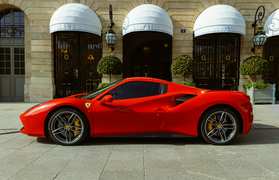 Why It’s Beautiful: The 250 GTO epitomizes “purposeful beauty.” It possesses the predatory stance of a hunter. Every vent serves a critical cooling function; every curve is meticulously sculpted to optimize airflow. It encapsulates a pivotal moment in automotive history where aerodynamic principles were understood through empirical observation rather than digital simulation, yielding organically flowing shapes in contrast to the sharp, angular aesthetics prevalent today.
Pagani Huayra (2011): The Da Vinci Code of Automotive Art
Designer: Horacio Pagani
Era: The Steampunk Digital Age
The Essence: Art and science in perfect symbiosis.
Horacio Pagani is not merely a manufacturer; he is an artist whose chosen medium is carbon fiber. The Huayra, named after the Quechua god of wind, is the material manifestation of his design philosophy. While the Zonda was his initial triumph, the Huayra represents the sophisticated maturation of his craft.
Design Language: The Huayra possesses an otherworldly allure, as if it has descended from a distant planet or emerged from a dimension where Leonardo da Vinci designed spacecraft. Its exterior mirrors extend with the delicate grace of leaves on a branch. The gullwing doors reveal an exquisite carbon-titanium monocoque. However, its true beauty resides in its active aerodynamics. The car is equipped with four independent flaps (two front, two rear) that articulate dynamically, akin to the ailerons of an aircraft. As the Huayra navigates corners, these flaps dance and adjust, imbuing the car with the appearance of a sentient organism reacting fluidly to the invisible currents of the wind.
Why It’s Beautiful: The exquisite attention to detail is what truly elevates the Huayra. Observe the titanium bolts, each meticulously laser-etched with the Pagani logo, a testament to the $80 per-bolt cost associated with their creation. The quad-pipe exhaust system, arranged in a compact circular cluster, resembles a Gatling gun or a jet thruster. The Huayra’s beauty is a direct consequence of its deliberate excess, intricate construction, and uncompromising craftsmanship, making it a prime example of Pagani supercar design.
Aston Martin One-77 (2009): The Golden Ratio Brute
Designer: Marek Reichman
Era: The Modern Era of Coachbuilding
The Essence: A heavyweight boxer dressed in a tuxedo.
Aston Martin has a storied legacy of producing aesthetically pleasing automobiles, exemplified by icons like the DB5 and DB9. However, the One-77 represents the absolute zenith of their design aspirations. This limited-production hypercar took the quintessential Aston Martin design language and amplified it to the extreme limits of proportion and execution.
Design Language: The One-77 is characterized by its astonishing width and exceptionally low stance. Its most defining feature is the prominent side strake. While previous Astons incorporated modest side vents, the One-77 features a dramatic cut-out within the front wheel arch, allowing a massive strake to sweep rearward and integrate seamlessly into the door panel. This creates a deep, shadowed chasm that runs the length of the car’s flank, giving the impression of having been exquisitely slashed by the claws of a formidable predator. The front grille is both imposing and elegantly proportioned. At the rear, a singular, unbroken strip of LED lighting curves harmoniously into the bodywork, a design element inspired by a calligraphic brushstroke.
Why It’s Beautiful: The One-77 masterfully employs the principles of the Golden Ratio (1:1.618), achieving a perfect equilibrium between the glasshouse and the body side. It manages to convey an aura of formidable aggression without sacrificing the inherent British sophistication that defines the Aston Martin marque. It embodies a compelling paradox: raw power cloaked in velvet elegance, a prime example of Aston Martin luxury supercar design.
Ford GT (2017): The Aerodynamic Sculpture
Designer: Christopher Svensson
Era: The Carbon Fiber Age
The Essence: A road-going Le Mans prototype.
The design process for most contemporary supercars typically involves a styling department followed by an aerodynamic review. The 2017 Ford GT, however, was conceived and refined within the confines of a wind tunnel, with stylists tasked with the imperative of preserving its aerodynamic integrity. The resultant design is nothing short of revolutionary.
Design Language: The Ford GT is best described as a “teardrop fuselage.” Viewed from above, its primary cabin adopts a narrow teardrop silhouette, reminiscent of a fighter jet’s cockpit. Its wheels are positioned extraordinarily far outboard from the main body, elegantly connected by “flying buttresses.” These structural elements are not merely decorative; they are integral to its aerodynamic function, channeling airflow along the car’s flanks and into the engine intakes while simultaneously generating crucial downforce. The rear of the car is remarkably hollow, with the heat exchangers visible through the taillight housings, showcasing an unparalleled level of engineering integration.
Why It’s Beautiful: Its beauty is characterized as “radical.” It deviates significantly from conventional automotive forms, appearing as if it has materialized from the pages of science fiction. The strategic use of negative space, the empty air gaps, is as vital to its aesthetic as the sculpted bodywork itself. The Ford GT convincingly demonstrates that uncompromising aerodynamic efficiency can yield a breathtakingly futuristic and stunning visual outcome, solidifying its place among Ford performance cars as a design icon.
Bugatti Chiron (2016): The Atlantic’s Distinguished Heir
Designer: Achim Anscheidt / Sasha Selipanov
Era: The Era of Unfettered Excess
The Essence: An embodiment of opulence, power, and rich heritage.
The challenge of designing a vehicle capable of exceeding 300 mph while maintaining an elegance befitting a valet at the Monaco casino is monumental. The Bugatti Chiron masterfully resolves this dichotomy. Despite its substantial bulk and considerable weight, it carries its mass with the dignified grace of a seasoned sumo wrestler.
Design Language: The Chiron is defined by its iconic “C-Line” (or Bugatti Line), a sweeping arc of polished aluminum that initiates at the A-pillar, elegantly curves behind the door, and then sweeps forward through the rocker panel. This distinctive element visually bifurcates the car’s two-tone paint schemes and serves as a critical air intake for its colossal W16 engine. The rear profile is bisected by a prominent “Spine” running down its center, a direct and respectful homage to the legendary Bugatti Type 57SC Atlantic of the 1930s. The rear taillight is a singular, unbroken bar of crimson light, seemingly suspended within a void of black.
Why It’s Beautiful: Its beauty can be described as “architectural.” The Chiron transcends the typical definition of a car, presenting itself more as a monumental structure or a piece of moving architecture. It possesses an undeniable presence that commands profound respect. The masterful synthesis of classical Art Deco influences with the aggressive design language of modern hypercars creates a timeless grandeur, setting a new standard for Bugatti luxury cars.
De Tomaso P72 (2019): The Modern Retro Revival
Designer: Jowyn Wong
Era: The Revival Era
The Essence: A vivid realization of 1960s Le Mans aspirations.
The De Tomaso P72 is a contemporary creation, yet it deliberately eschews the conventional aesthetics of modern automobiles. It stands as a heartfelt tribute to the prototype race cars of the 1960s, drawing specific inspiration from the De Tomaso P70. In an automotive landscape frequently dominated by sharp edges and aggressive front fascias, the P72 stands out with its flowing curves and soft, organic lines.
Why It’s Beautiful: The 250 GTO epitomizes “purposeful beauty.” It possesses the predatory stance of a hunter. Every vent serves a critical cooling function; every curve is meticulously sculpted to optimize airflow. It encapsulates a pivotal moment in automotive history where aerodynamic principles were understood through empirical observation rather than digital simulation, yielding organically flowing shapes in contrast to the sharp, angular aesthetics prevalent today.
Pagani Huayra (2011): The Da Vinci Code of Automotive Art
Designer: Horacio Pagani
Era: The Steampunk Digital Age
The Essence: Art and science in perfect symbiosis.
Horacio Pagani is not merely a manufacturer; he is an artist whose chosen medium is carbon fiber. The Huayra, named after the Quechua god of wind, is the material manifestation of his design philosophy. While the Zonda was his initial triumph, the Huayra represents the sophisticated maturation of his craft.
Design Language: The Huayra possesses an otherworldly allure, as if it has descended from a distant planet or emerged from a dimension where Leonardo da Vinci designed spacecraft. Its exterior mirrors extend with the delicate grace of leaves on a branch. The gullwing doors reveal an exquisite carbon-titanium monocoque. However, its true beauty resides in its active aerodynamics. The car is equipped with four independent flaps (two front, two rear) that articulate dynamically, akin to the ailerons of an aircraft. As the Huayra navigates corners, these flaps dance and adjust, imbuing the car with the appearance of a sentient organism reacting fluidly to the invisible currents of the wind.
Why It’s Beautiful: The exquisite attention to detail is what truly elevates the Huayra. Observe the titanium bolts, each meticulously laser-etched with the Pagani logo, a testament to the $80 per-bolt cost associated with their creation. The quad-pipe exhaust system, arranged in a compact circular cluster, resembles a Gatling gun or a jet thruster. The Huayra’s beauty is a direct consequence of its deliberate excess, intricate construction, and uncompromising craftsmanship, making it a prime example of Pagani supercar design.
Aston Martin One-77 (2009): The Golden Ratio Brute
Designer: Marek Reichman
Era: The Modern Era of Coachbuilding
The Essence: A heavyweight boxer dressed in a tuxedo.
Aston Martin has a storied legacy of producing aesthetically pleasing automobiles, exemplified by icons like the DB5 and DB9. However, the One-77 represents the absolute zenith of their design aspirations. This limited-production hypercar took the quintessential Aston Martin design language and amplified it to the extreme limits of proportion and execution.
Design Language: The One-77 is characterized by its astonishing width and exceptionally low stance. Its most defining feature is the prominent side strake. While previous Astons incorporated modest side vents, the One-77 features a dramatic cut-out within the front wheel arch, allowing a massive strake to sweep rearward and integrate seamlessly into the door panel. This creates a deep, shadowed chasm that runs the length of the car’s flank, giving the impression of having been exquisitely slashed by the claws of a formidable predator. The front grille is both imposing and elegantly proportioned. At the rear, a singular, unbroken strip of LED lighting curves harmoniously into the bodywork, a design element inspired by a calligraphic brushstroke.
Why It’s Beautiful: The One-77 masterfully employs the principles of the Golden Ratio (1:1.618), achieving a perfect equilibrium between the glasshouse and the body side. It manages to convey an aura of formidable aggression without sacrificing the inherent British sophistication that defines the Aston Martin marque. It embodies a compelling paradox: raw power cloaked in velvet elegance, a prime example of Aston Martin luxury supercar design.
Ford GT (2017): The Aerodynamic Sculpture
Designer: Christopher Svensson
Era: The Carbon Fiber Age
The Essence: A road-going Le Mans prototype.
The design process for most contemporary supercars typically involves a styling department followed by an aerodynamic review. The 2017 Ford GT, however, was conceived and refined within the confines of a wind tunnel, with stylists tasked with the imperative of preserving its aerodynamic integrity. The resultant design is nothing short of revolutionary.
Design Language: The Ford GT is best described as a “teardrop fuselage.” Viewed from above, its primary cabin adopts a narrow teardrop silhouette, reminiscent of a fighter jet’s cockpit. Its wheels are positioned extraordinarily far outboard from the main body, elegantly connected by “flying buttresses.” These structural elements are not merely decorative; they are integral to its aerodynamic function, channeling airflow along the car’s flanks and into the engine intakes while simultaneously generating crucial downforce. The rear of the car is remarkably hollow, with the heat exchangers visible through the taillight housings, showcasing an unparalleled level of engineering integration.
Why It’s Beautiful: Its beauty is characterized as “radical.” It deviates significantly from conventional automotive forms, appearing as if it has materialized from the pages of science fiction. The strategic use of negative space, the empty air gaps, is as vital to its aesthetic as the sculpted bodywork itself. The Ford GT convincingly demonstrates that uncompromising aerodynamic efficiency can yield a breathtakingly futuristic and stunning visual outcome, solidifying its place among Ford performance cars as a design icon.
Bugatti Chiron (2016): The Atlantic’s Distinguished Heir
Designer: Achim Anscheidt / Sasha Selipanov
Era: The Era of Unfettered Excess
The Essence: An embodiment of opulence, power, and rich heritage.
The challenge of designing a vehicle capable of exceeding 300 mph while maintaining an elegance befitting a valet at the Monaco casino is monumental. The Bugatti Chiron masterfully resolves this dichotomy. Despite its substantial bulk and considerable weight, it carries its mass with the dignified grace of a seasoned sumo wrestler.
Design Language: The Chiron is defined by its iconic “C-Line” (or Bugatti Line), a sweeping arc of polished aluminum that initiates at the A-pillar, elegantly curves behind the door, and then sweeps forward through the rocker panel. This distinctive element visually bifurcates the car’s two-tone paint schemes and serves as a critical air intake for its colossal W16 engine. The rear profile is bisected by a prominent “Spine” running down its center, a direct and respectful homage to the legendary Bugatti Type 57SC Atlantic of the 1930s. The rear taillight is a singular, unbroken bar of crimson light, seemingly suspended within a void of black.
Why It’s Beautiful: Its beauty can be described as “architectural.” The Chiron transcends the typical definition of a car, presenting itself more as a monumental structure or a piece of moving architecture. It possesses an undeniable presence that commands profound respect. The masterful synthesis of classical Art Deco influences with the aggressive design language of modern hypercars creates a timeless grandeur, setting a new standard for Bugatti luxury cars.
De Tomaso P72 (2019): The Modern Retro Revival
Designer: Jowyn Wong
Era: The Revival Era
The Essence: A vivid realization of 1960s Le Mans aspirations.
The De Tomaso P72 is a contemporary creation, yet it deliberately eschews the conventional aesthetics of modern automobiles. It stands as a heartfelt tribute to the prototype race cars of the 1960s, drawing specific inspiration from the De Tomaso P70. In an automotive landscape frequently dominated by sharp edges and aggressive front fascias, the P72 stands out with its flowing curves and soft, organic lines.
 Design Language: The P72 features pronounced, voluptuous wheel arches that arch high above the hood, providing the driver with exceptional spatial awareness for precise track positioning. The greenhouse is shaped like a delicate glass teardrop. The side mirrors are elegantly mounted on the fenders, resembling precious jewels. However, it is the interior where the P72’s beauty truly captivates. It is adorned with polished copper accents, exquisite diamond-quilted leather, and analog gauges that evoke the craftsmanship of high-end Swiss timepieces. The exposed manual gear linkage, even though the car utilizes a sequential transmission, transforms the mechanical connection into a work of art, celebrating the tactile engagement of driving.
Why It’s Beautiful: The P72 embodies pure automotive romance. It evokes a bygone era when racing was inherently more dangerous and the cars were exceptionally beautiful. It unequivocally proves that a modern vehicle constructed on a carbon-fiber chassis need not adopt a robotic or aggressive demeanor. It is fluid, organic, and possesses a breathtaking elegance, representing a unique niche in classic supercar revival designs.
Ferrari Daytona SP3 (2021): The Synthesis of History and Future
Designer: Flavio Manzoni
Era: The Icona Series
The Essence: A masterfully remastered greatest hits collection from the 1960s.
The Daytona SP3 is a cornerstone of Ferrari’s celebrated “Icona” series, a collection of vehicles meticulously crafted to honor Ferrari’s rich heritage through the application of cutting-edge modern technology. Its design is profoundly inspired by the iconic 330 P3/4 race cars that dominated the 1967 24 Hours of Daytona.
Design Language: This car is a pure testament to automotive sculpture. The front profile is characterized by a distinctive “wraparound” windshield that artfully conceals the A-pillars, creating the illusion that the roof is floating independently – a design often referred to as the “Visor” look. The side mirrors are strategically positioned far forward on the fenders. The rear of the car is arguably its most arresting feature, boasting a stack of horizontal blades (strakes) that traverse the entire width of the vehicle. Positioned beneath these blades are the taillights and cooling vents, resulting in a design that is simultaneously futuristic and cyberpunk-inspired, while subtly referencing the vent treatments of classic 1980s concept cars.
Why It’s Beautiful: The Daytona SP3 achieves a remarkable equilibrium between nostalgia and futurism. It is not a mere retro pastiche; rather, it presents a compelling vision of what the 1960s might have imagined the future would look like. From every angle, it is wide, low, and dramatically proportioned. It is, by many accounts, the most beautiful Ferrari to emerge from the 21st century, a pinnacle of Ferrari Icona series design.
McLaren F1 (1992): The Epitome of Proportional Perfection
Designer: Peter Stevens
Era: The Analog Peak
The Essence: Compact, efficient, and utterly pure.
The inclusion of the McLaren F1 might prompt some to question its place on a list prioritizing beauty over raw performance. While Gordon Murray was the engineering mastermind, Peter Stevens was responsible for its iconic exterior styling. Over time, the F1 has aged with an elegance that few other supercars can match.
Design Language: The McLaren F1 is remarkably compact, even smaller than many contemporary sports cars. The ingenious packaging of its V12 engine and three-seat configuration within such a constrained footprint results in taut, muscular proportions. There is absolutely no wasted space. It foregoes large, overt wings, instead relying on advanced fan and underbody aerodynamics. Its lines are exceptionally smooth, clean, and unadorned. The distinctive central driving position dictates a unique, symmetrical canopy design, reminiscent of a fighter jet’s cockpit.
Why It’s Beautiful: Its beauty is best described as “minimalist.” In an era where modern vehicles often feature superfluous fake vents and gratuitous creases, the McLaren F1 stands as a paragon of simplicity, much like a perfectly crafted bar of soap. Its purity is undeniable. Its aesthetic appeal stems directly from its efficient packaging and its unadulterated honesty. It looks precisely what it is: the ultimate driving machine. This enduring appeal makes it a perennial contender in discussions of iconic supercar design.
The Technical Conundrum: Engineering’s Impact on Supercar Aesthetics
The persistent question arises: why is it so challenging to engineer a truly beautiful supercar in the modern era? The answer lies in an inherent conflict between the immutable laws of thermodynamics and the subjective pursuit of aesthetics.
The Fundamental Conflict:
Cooling Demands: A 1000-horsepower engine generates immense thermal energy. To dissipate this heat, massive radiators and substantial air intakes are indispensable. These often disrupt the elegant lines of a car’s front fascia, compromising its visual harmony.
Downforce Requirements: To maintain stability and grip at extreme velocities approaching 200 mph, significant downforce is necessary. The most effective method for generating downforce typically involves the integration of large rear wings and front canards, which invariably alter and often detract from a car’s clean silhouette. Consider the stark contrast between the sleek McLaren F1 and the aggressively aerodynamically optimized McLaren Senna.
Safety Regulations: Modern pedestrian safety standards mandate higher hood lines, while stringent crash safety requirements necessitate thicker A-pillars. These regulatory constraints contribute to a bulkier, less sleek appearance compared to vehicles from previous decades.
The Artistic Resolution:
The supercars featured on this list, such as the Ford GT and the Pagani Huayra, achieve their visual brilliance by ingeniously transforming these technical challenges into artistic triumphs.
Instead of an obtrusive rear wing, Pagani employs sophisticated active aerodynamic flaps.
Rather than a voluminous rear end solely for cooling, the Ford GT utilizes its innovative flying buttresses to manage airflow and create visual interest through negative space.
Rather than allowing massive intakes to mar the side profile, Bugatti seamlessly integrates the intake function into its signature “C-Line.”
Ultimately, the most beautiful supercars are those where sophisticated engineering not only supports but actively enhances the artistic vision, rather than acting as a constraint.
Conclusion: The Subjective Realm of Beauty
Beauty, in the automotive sphere, remains profoundly subjective. Your personal preference might lean towards the sharp, origami-like creases of a Lamborghini Countach (an honorable mention not on this list) or the stark, Teutonic precision of a Porsche 918 Spyder.
However, the ten vehicles meticulously selected above represent the absolute pinnacles of their respective design eras and technological capabilities. The Miura and the 33 Stradale embody the organic, human-centric artistry of the 1960s. The One-77 and the Huayra showcase the boundless potential of contemporary craftsmanship and advanced materials. The Daytona SP3 and the P72 beautifully articulate our intrinsic desire to bridge the future with the enduring romance of the past.
A truly beautiful supercar transcends mere transportation from point A to point B. It possesses the power to transport the observer into a state of pure awe, compelling them to halt, turn, and simply gaze. In that fleeting moment, the specific horsepower figures, the astronomical price tags, and the ultimate top speed fade into irrelevance. What remains is the purity of the line, the interplay of light and shadow, and the exquisite curve of the form. This is the profound and enduring power of exceptional automotive design.
Design Language: The P72 features pronounced, voluptuous wheel arches that arch high above the hood, providing the driver with exceptional spatial awareness for precise track positioning. The greenhouse is shaped like a delicate glass teardrop. The side mirrors are elegantly mounted on the fenders, resembling precious jewels. However, it is the interior where the P72’s beauty truly captivates. It is adorned with polished copper accents, exquisite diamond-quilted leather, and analog gauges that evoke the craftsmanship of high-end Swiss timepieces. The exposed manual gear linkage, even though the car utilizes a sequential transmission, transforms the mechanical connection into a work of art, celebrating the tactile engagement of driving.
Why It’s Beautiful: The P72 embodies pure automotive romance. It evokes a bygone era when racing was inherently more dangerous and the cars were exceptionally beautiful. It unequivocally proves that a modern vehicle constructed on a carbon-fiber chassis need not adopt a robotic or aggressive demeanor. It is fluid, organic, and possesses a breathtaking elegance, representing a unique niche in classic supercar revival designs.
Ferrari Daytona SP3 (2021): The Synthesis of History and Future
Designer: Flavio Manzoni
Era: The Icona Series
The Essence: A masterfully remastered greatest hits collection from the 1960s.
The Daytona SP3 is a cornerstone of Ferrari’s celebrated “Icona” series, a collection of vehicles meticulously crafted to honor Ferrari’s rich heritage through the application of cutting-edge modern technology. Its design is profoundly inspired by the iconic 330 P3/4 race cars that dominated the 1967 24 Hours of Daytona.
Design Language: This car is a pure testament to automotive sculpture. The front profile is characterized by a distinctive “wraparound” windshield that artfully conceals the A-pillars, creating the illusion that the roof is floating independently – a design often referred to as the “Visor” look. The side mirrors are strategically positioned far forward on the fenders. The rear of the car is arguably its most arresting feature, boasting a stack of horizontal blades (strakes) that traverse the entire width of the vehicle. Positioned beneath these blades are the taillights and cooling vents, resulting in a design that is simultaneously futuristic and cyberpunk-inspired, while subtly referencing the vent treatments of classic 1980s concept cars.
Why It’s Beautiful: The Daytona SP3 achieves a remarkable equilibrium between nostalgia and futurism. It is not a mere retro pastiche; rather, it presents a compelling vision of what the 1960s might have imagined the future would look like. From every angle, it is wide, low, and dramatically proportioned. It is, by many accounts, the most beautiful Ferrari to emerge from the 21st century, a pinnacle of Ferrari Icona series design.
McLaren F1 (1992): The Epitome of Proportional Perfection
Designer: Peter Stevens
Era: The Analog Peak
The Essence: Compact, efficient, and utterly pure.
The inclusion of the McLaren F1 might prompt some to question its place on a list prioritizing beauty over raw performance. While Gordon Murray was the engineering mastermind, Peter Stevens was responsible for its iconic exterior styling. Over time, the F1 has aged with an elegance that few other supercars can match.
Design Language: The McLaren F1 is remarkably compact, even smaller than many contemporary sports cars. The ingenious packaging of its V12 engine and three-seat configuration within such a constrained footprint results in taut, muscular proportions. There is absolutely no wasted space. It foregoes large, overt wings, instead relying on advanced fan and underbody aerodynamics. Its lines are exceptionally smooth, clean, and unadorned. The distinctive central driving position dictates a unique, symmetrical canopy design, reminiscent of a fighter jet’s cockpit.
Why It’s Beautiful: Its beauty is best described as “minimalist.” In an era where modern vehicles often feature superfluous fake vents and gratuitous creases, the McLaren F1 stands as a paragon of simplicity, much like a perfectly crafted bar of soap. Its purity is undeniable. Its aesthetic appeal stems directly from its efficient packaging and its unadulterated honesty. It looks precisely what it is: the ultimate driving machine. This enduring appeal makes it a perennial contender in discussions of iconic supercar design.
The Technical Conundrum: Engineering’s Impact on Supercar Aesthetics
The persistent question arises: why is it so challenging to engineer a truly beautiful supercar in the modern era? The answer lies in an inherent conflict between the immutable laws of thermodynamics and the subjective pursuit of aesthetics.
The Fundamental Conflict:
Cooling Demands: A 1000-horsepower engine generates immense thermal energy. To dissipate this heat, massive radiators and substantial air intakes are indispensable. These often disrupt the elegant lines of a car’s front fascia, compromising its visual harmony.
Downforce Requirements: To maintain stability and grip at extreme velocities approaching 200 mph, significant downforce is necessary. The most effective method for generating downforce typically involves the integration of large rear wings and front canards, which invariably alter and often detract from a car’s clean silhouette. Consider the stark contrast between the sleek McLaren F1 and the aggressively aerodynamically optimized McLaren Senna.
Safety Regulations: Modern pedestrian safety standards mandate higher hood lines, while stringent crash safety requirements necessitate thicker A-pillars. These regulatory constraints contribute to a bulkier, less sleek appearance compared to vehicles from previous decades.
The Artistic Resolution:
The supercars featured on this list, such as the Ford GT and the Pagani Huayra, achieve their visual brilliance by ingeniously transforming these technical challenges into artistic triumphs.
Instead of an obtrusive rear wing, Pagani employs sophisticated active aerodynamic flaps.
Rather than a voluminous rear end solely for cooling, the Ford GT utilizes its innovative flying buttresses to manage airflow and create visual interest through negative space.
Rather than allowing massive intakes to mar the side profile, Bugatti seamlessly integrates the intake function into its signature “C-Line.”
Ultimately, the most beautiful supercars are those where sophisticated engineering not only supports but actively enhances the artistic vision, rather than acting as a constraint.
Conclusion: The Subjective Realm of Beauty
Beauty, in the automotive sphere, remains profoundly subjective. Your personal preference might lean towards the sharp, origami-like creases of a Lamborghini Countach (an honorable mention not on this list) or the stark, Teutonic precision of a Porsche 918 Spyder.
However, the ten vehicles meticulously selected above represent the absolute pinnacles of their respective design eras and technological capabilities. The Miura and the 33 Stradale embody the organic, human-centric artistry of the 1960s. The One-77 and the Huayra showcase the boundless potential of contemporary craftsmanship and advanced materials. The Daytona SP3 and the P72 beautifully articulate our intrinsic desire to bridge the future with the enduring romance of the past.
A truly beautiful supercar transcends mere transportation from point A to point B. It possesses the power to transport the observer into a state of pure awe, compelling them to halt, turn, and simply gaze. In that fleeting moment, the specific horsepower figures, the astronomical price tags, and the ultimate top speed fade into irrelevance. What remains is the purity of the line, the interplay of light and shadow, and the exquisite curve of the form. This is the profound and enduring power of exceptional automotive design.
 If you’re captivated by the artistry and engineering prowess of these magnificent machines and are considering acquiring one or exploring further, we invite you to connect with our team of automotive specialists. Let us guide you through the world of these rolling sculptures and help you find the perfect masterpiece to fulfill your own automotive dreams.