
The Titans of Torque: Revisiting the 10 Classic Supercars That Forged Automotive Legend
The Analog Heartbeat: More Than Just Horsepower
In the dazzling landscape of 2025, where even family SUVs boast the kind of acceleration that would have been considered otherworldly a generation ago, speed has become an easily accessible commodity. We command blistering performance with quiet, digitized precision, often while multitasking our way through daily life. But before the seamless integration of technology and the democratization of raw power, there existed a breed of automobile where velocity was a raw, untamed, and deeply visceral experience. These weren’t merely vehicles; they were mechanical symphonies played out on asphalt, demanding a partnership forged in skill, courage, and an appreciation for the analog soul.
Classic supercars stand as magnificent time capsules, originating from an era where the raw communication between driver and machine was paramount. This was a time before the omnipresent digital nanny of traction control, before the convenience of paddle shifters, and crucially, before the relentless march of emissions regulations began to mute the glorious roar of the internal combustion engine. These were machines that required a firm hand on the wheel, a patient ear for engine warm-ups, and a profound respect to truly master. Their aroma was a potent blend of unburnt hydrocarbons, supple Connolly leather, and the intoxicating scent of hot oil. To pilot a modern hypercar is akin to navigating a sophisticated video game. To wrestle with a classic supercar is to engage in a thrilling, often perilous, dance with a mechanical beast that demands absolute concentration and unwavering nerve.
From the sun-drenched hills of Italy to the limitless horizons of the German autobahns, these are the ten classic supercars that not only defined an era but laid the very foundations for the breathtaking machines we admire today. Their legacy isn’t just in their speed, but in the sheer audacity of their engineering and the enduring romance they inspire among automotive enthusiasts and collectors alike. These are the icons that continue to captivate, proving that true automotive excellence transcends mere chronological age.
Lamborghini Miura P400 (1966-1973): The Dawn of a New Supercar Dynasty
Engine: 3.9L V12
Horsepower: 345 – 380 hp
Top Speed: 171 mph (275 km/h)
Origin: Italy
Before 1966, the pinnacle of automotive performance was largely defined by the front-engined grand tourer. Think of the elegance of a Ferrari 275 GTB, where the driver sat behind a commanding, long bonnet, enjoying rapid straight-line progress. The Lamborghini Miura, however, shattered this paradigm overnight. It was a revelation, and arguably the genesis of the modern supercar. Lamborghini audaciousness brought Formula 1 technology to the street by mounting its V12 engine transversely behind the driver – a revolutionary mid-engine configuration. This layout, previously the exclusive domain of cutting-edge race cars, fundamentally redefined the potential for a road-going automobile, setting a blueprint that countless successors would follow.
The visual masterpiece that is the Miura was penned by a then-22-year-old Marcello Gandini at Bertone. Its sculpted lines have consistently earned it a place among the most beautiful cars ever created, often described as an alluring figure in repose. The distinctive “eyelashes” framing the headlights, the intricate louvers gracing the rear engine cover, and the theatrical clam-shell opening mechanisms all contributed to an unparalleled sense of automotive drama and artistry.
To drive a Miura is an experience that is simultaneously terrifying and breathtakingly beautiful. The potent V12 engine resides mere inches from your ears, its thunderous symphony audible through a thin partition of glass and carpet. At exhilarating speeds, the car’s nose exhibited a tendency to become light due to aerodynamic lift – a challenge engineers hadn’t yet fully countered with downforce. Driving a Miura isn’t about delicate inputs; it’s an exercise in courage and decisive action. It was, without question, the undisputed rockstar of the 1960s, a rolling sculpture that commanded attention wherever it went.
Ferrari F40 (1987-1992): The Final Testament to Enzo’s Vision
Engine: 2.9L Twin-Turbo V8
Horsepower: 471 hp
Top Speed: 201 mph (324 km/h)
Origin: Italy
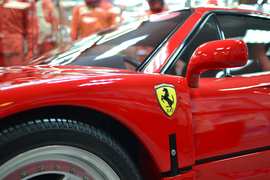
The Ferrari F40 represents more than just a remarkable car; it is the final wish of Enzo Ferrari, personally greenlit by the legendary patriarch before his passing. His directive to his engineers was simple yet monumental: “Build a car that is the best in the world.” The result was a road-legal race car that achieved the extraordinary feat of being the first production automobile to shatter the 200 mph barrier. The F40 stands as an uncompromising testament to pure performance.
Luxury was deliberately omitted in favor of brute force and minimal weight. The body panels, constructed from Kevlar and carbon fiber, were so thinly painted that the carbon weave is often visible, a stark visual cue to its race-bred origins. Amenities were stripped to the bone: no radio, no carpets, no air conditioning, and even the door handles were replaced by simple pull cords. The windows were basic plastic sliders. It was an exercise in focused, unadulterated aggression – raw, brutal, and utterly purpose-built.
The F40 is famously characterized by its dramatic turbo lag. Below 4,000 RPM, it behaves with a surprising docility, almost like a conventional sedan. But when the twin IHI turbochargers unleash their fury, all hell breaks loose. The surge of power arrives in a violent, earth-shattering explosion that strains the rear tires to their absolute limit. With absolutely no driver aids – no ABS, no traction control, and no power steering – it’s a pure, unadulterated dialogue between the driver, the three pedals, and the satisfyingly mechanical click of the gated shifter. To this day, the F40 remains the benchmark for uncompromised driver engagement and a celebrated icon among performance cars.
Mercedes-Benz 300 SL “Gullwing” (1954-1957): The Pioneer of Supercar Ambition
Engine: 3.0L Inline-6
Horsepower: 215 hp
Top Speed: 160 mph (260 km/h)
Origin: Germany
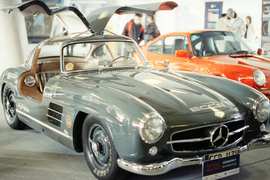
 While the Lamborghini Miura might have codified the layout of the supercar, the Mercedes-Benz 300 SL “Gullwing” firmly established the very concept. In the 1950s, a time when many cars struggled to comfortably exceed 70 mph, the Gullwing was capable of a staggering 160 mph. It was, quite literally, a road-legal version of the W194 race car that had dominated Le Mans. This wasn’t just a fast car for its time; it was a quantum leap in automotive performance for a production model.
The iconic “Gullwing” doors were not a mere stylistic flourish but an ingenious engineering solution. The car utilized a robust tubular spaceframe chassis, which, while incredibly strong, necessitated high side sills. Conventional doors would have compromised the chassis’s integrity. Thus, the innovative solution was to hinge the doors from the roof, creating a design that was as functional as it was breathtaking. Furthermore, the 300 SL was a pioneer in automotive technology, being the first production car to feature Direct Fuel Injection, a technology that wouldn’t become commonplace in mainstream vehicles for another half-century.
Driving the 300 SL is a demanding yet rewarding experience. Its swing-axle rear suspension, while contributing to its exceptional handling on straight roads, could become a handful if the throttle was lifted mid-corner, potentially leading to a dramatic spin. However, on a clear stretch of asphalt, its acceleration was formidable, pulling with the relentless force of a freight train. The interior, a meticulous blend of plaid fabric and purposeful metal toggle switches, exuded an air of purposeful luxury. The 300 SL stands as the revered grandfather of every modern supercar, a testament to German engineering prowess and visionary design.
McLaren F1 (1992-1998): The Pinnacle of Automotive Engineering
Engine: 6.1L BMW V12 (Naturally Aspirated)
Horsepower: 618 hp
Top Speed: 240 mph (386 km/h)
Origin: United Kingdom
The question of whether the McLaren F1 is a “classic” is almost rhetorical. With well over three decades of existence, it has unequivocally earned its place among the automotive pantheon. Many would argue it is, quite simply, the greatest car ever constructed. Gordon Murray, the visionary designer, was driven by an obsessive pursuit of lightness, culminating in a car that boasted a unique central driving position (accommodating three occupants), an engine bay lined with gold foil for superior heat reflection, and a groundbreaking carbon fiber monocoque chassis. For over a decade, it held the production car speed record, and it remains the fastest naturally aspirated car ever produced – a feat that continues to inspire awe.
Visually, the F1 appears remarkably compact by contemporary hypercar standards. It eschews ostentatious wings and aggressive splitters, achieving its immense velocity through pure aerodynamic efficiency and an almost complete absence of drag. Its design is eternally timeless supercars, a testament to function dictating form in the most elegant manner.
The naturally aspirated BMW V12 engine is the undeniable heart of the F1, delivering instantaneous throttle response and a symphony of mechanical perfection. The central driving position affords unparalleled visibility, creating an intimate connection between driver and machine. With no power steering or brake assist, the feedback is telepathic, allowing the driver to feel every nuance of the road. Driving the F1 is widely considered the “Holy Grail” of automotive experiences – an unparalleled fusion of man and machine that, due to the evolution of safety regulations, is unlikely to be replicated. It is a truly exceptional luxury sports car.
Porsche 959 (1986-1993): The Technological Trailblazer
Engine: 2.8L Twin-Turbo Flat-Six
Horsepower: 444 hp
Top Speed: 197 mph (317 km/h)
Origin: Germany
While the Ferrari F40 was a raw, visceral homage to motorsport simplicity, the Porsche 959 was resolutely focused on the future. It was, without question, the most technologically advanced automobile of the 1980s, a veritable rolling laboratory that introduced the world to innovations we now take for granted. Among its groundbreaking features were an adjustable suspension system, tire pressure monitoring sensors, and, most significantly, a revolutionary computer-controlled all-wheel-drive system.
Its aesthetic, perhaps best described as a “melted 911,” was born from its intended purpose in the brutal world of Group B rallying. The wide body, integrated spoilers, and extensive air vents were all dictated by aerodynamic necessity rather than traditional beauty. Yet, its form was undeniably functional, achieving exceptional aerodynamic efficiency.
The 959 offered a remarkably accessible supercar experience. Where the F40 challenged and threatened, the 959 actively assisted the driver. Its advanced AWD system could dynamically redistribute power to individual wheels, maximizing grip in virtually any condition. This was a car capable of traversing snow, tackling a race track, and then comfortably returning home with the air conditioning humming. It was a significant precursor to modern performance machines like the Bugatti Veyron and the Porsche 918 Spyder, showcasing the potential for all-wheel-drive supercars.
Lamborghini Countach LP400 (1974-1990): The Poster Child of Automotive Desire
Engine: 3.9L – 5.2L V12
Horsepower: 370 – 455 hp
Top Speed: 179 mph (288 km/h)
Origin: Italy
For an entire generation of teenagers in the 1980s, the Lamborghini Countach was more than just a car; it was the ultimate bedroom wall poster. It single-handedly defined the “wedge” shape in automotive design, a radical departure from the curvaceous lines that had previously dominated. The Countach was a riot of sharp angles, flat planes, and the now-iconic scissor doors. The very name, “Countach,” is a Piedmontese exclamation of astonishment, translating roughly to “Wow!” or “Damn!” – a fitting descriptor for its impact.
Another masterpiece from Marcello Gandini, the early “Periscopio” models exuded a clean, pure form. Later iterations, such as the “5000 QV,” embraced a more aggressive aesthetic, adorned with prominent wings and flared arches, becoming the quintessential “Wolf of Wall Street” look. Its practicality was virtually nonexistent; it was immensely wide, notoriously difficult to see out of, and often required the driver to perch on the sill to maneuver in tight spaces.
The driving experience was as demanding as its appearance was dramatic. The steering, clutch, and gearshift all required significant physical effort. The cabin could become exceptionally hot. However, the intoxicating roar of the carbureted V12 and the sheer public adulation it commanded were unparalleled. Even decades later, a Countach commands attention like a UFO descending from the sky, a testament to its enduring visual and auditory impact. It remains a prime example of exotic sports cars.
Ferrari 250 GTO (1962-1964): The Pinnacle of Rarity and Racing Prowess
Engine: 3.0L V12
Horsepower: 300 hp
Top Speed: 174 mph (280 km/h)
Origin: Italy
The Ferrari 250 GTO holds the distinction of being the most valuable car in the world, with auction prices regularly soaring past the $50 million mark. This extraordinary valuation stems from a perfect storm of factors: unparalleled beauty, extreme rarity (only 36 were ever produced), and an impeccable racing pedigree. It represents the final chapter of front-engined Ferrari racing cars before the mid-engine revolution took hold.
Designed by Scaglietti, its aerodynamic form was not only functional but also a work of pure automotive art. The long, purposeful bonnet, the distinctive Kamm-tail rear, and the three iconic “D-shaped” vents on the nose are instantly recognizable hallmarks of its design genius.
While the Lamborghini Miura might have codified the layout of the supercar, the Mercedes-Benz 300 SL “Gullwing” firmly established the very concept. In the 1950s, a time when many cars struggled to comfortably exceed 70 mph, the Gullwing was capable of a staggering 160 mph. It was, quite literally, a road-legal version of the W194 race car that had dominated Le Mans. This wasn’t just a fast car for its time; it was a quantum leap in automotive performance for a production model.
The iconic “Gullwing” doors were not a mere stylistic flourish but an ingenious engineering solution. The car utilized a robust tubular spaceframe chassis, which, while incredibly strong, necessitated high side sills. Conventional doors would have compromised the chassis’s integrity. Thus, the innovative solution was to hinge the doors from the roof, creating a design that was as functional as it was breathtaking. Furthermore, the 300 SL was a pioneer in automotive technology, being the first production car to feature Direct Fuel Injection, a technology that wouldn’t become commonplace in mainstream vehicles for another half-century.
Driving the 300 SL is a demanding yet rewarding experience. Its swing-axle rear suspension, while contributing to its exceptional handling on straight roads, could become a handful if the throttle was lifted mid-corner, potentially leading to a dramatic spin. However, on a clear stretch of asphalt, its acceleration was formidable, pulling with the relentless force of a freight train. The interior, a meticulous blend of plaid fabric and purposeful metal toggle switches, exuded an air of purposeful luxury. The 300 SL stands as the revered grandfather of every modern supercar, a testament to German engineering prowess and visionary design.
McLaren F1 (1992-1998): The Pinnacle of Automotive Engineering
Engine: 6.1L BMW V12 (Naturally Aspirated)
Horsepower: 618 hp
Top Speed: 240 mph (386 km/h)
Origin: United Kingdom
The question of whether the McLaren F1 is a “classic” is almost rhetorical. With well over three decades of existence, it has unequivocally earned its place among the automotive pantheon. Many would argue it is, quite simply, the greatest car ever constructed. Gordon Murray, the visionary designer, was driven by an obsessive pursuit of lightness, culminating in a car that boasted a unique central driving position (accommodating three occupants), an engine bay lined with gold foil for superior heat reflection, and a groundbreaking carbon fiber monocoque chassis. For over a decade, it held the production car speed record, and it remains the fastest naturally aspirated car ever produced – a feat that continues to inspire awe.
Visually, the F1 appears remarkably compact by contemporary hypercar standards. It eschews ostentatious wings and aggressive splitters, achieving its immense velocity through pure aerodynamic efficiency and an almost complete absence of drag. Its design is eternally timeless supercars, a testament to function dictating form in the most elegant manner.
The naturally aspirated BMW V12 engine is the undeniable heart of the F1, delivering instantaneous throttle response and a symphony of mechanical perfection. The central driving position affords unparalleled visibility, creating an intimate connection between driver and machine. With no power steering or brake assist, the feedback is telepathic, allowing the driver to feel every nuance of the road. Driving the F1 is widely considered the “Holy Grail” of automotive experiences – an unparalleled fusion of man and machine that, due to the evolution of safety regulations, is unlikely to be replicated. It is a truly exceptional luxury sports car.
Porsche 959 (1986-1993): The Technological Trailblazer
Engine: 2.8L Twin-Turbo Flat-Six
Horsepower: 444 hp
Top Speed: 197 mph (317 km/h)
Origin: Germany
While the Ferrari F40 was a raw, visceral homage to motorsport simplicity, the Porsche 959 was resolutely focused on the future. It was, without question, the most technologically advanced automobile of the 1980s, a veritable rolling laboratory that introduced the world to innovations we now take for granted. Among its groundbreaking features were an adjustable suspension system, tire pressure monitoring sensors, and, most significantly, a revolutionary computer-controlled all-wheel-drive system.
Its aesthetic, perhaps best described as a “melted 911,” was born from its intended purpose in the brutal world of Group B rallying. The wide body, integrated spoilers, and extensive air vents were all dictated by aerodynamic necessity rather than traditional beauty. Yet, its form was undeniably functional, achieving exceptional aerodynamic efficiency.
The 959 offered a remarkably accessible supercar experience. Where the F40 challenged and threatened, the 959 actively assisted the driver. Its advanced AWD system could dynamically redistribute power to individual wheels, maximizing grip in virtually any condition. This was a car capable of traversing snow, tackling a race track, and then comfortably returning home with the air conditioning humming. It was a significant precursor to modern performance machines like the Bugatti Veyron and the Porsche 918 Spyder, showcasing the potential for all-wheel-drive supercars.
Lamborghini Countach LP400 (1974-1990): The Poster Child of Automotive Desire
Engine: 3.9L – 5.2L V12
Horsepower: 370 – 455 hp
Top Speed: 179 mph (288 km/h)
Origin: Italy
For an entire generation of teenagers in the 1980s, the Lamborghini Countach was more than just a car; it was the ultimate bedroom wall poster. It single-handedly defined the “wedge” shape in automotive design, a radical departure from the curvaceous lines that had previously dominated. The Countach was a riot of sharp angles, flat planes, and the now-iconic scissor doors. The very name, “Countach,” is a Piedmontese exclamation of astonishment, translating roughly to “Wow!” or “Damn!” – a fitting descriptor for its impact.
Another masterpiece from Marcello Gandini, the early “Periscopio” models exuded a clean, pure form. Later iterations, such as the “5000 QV,” embraced a more aggressive aesthetic, adorned with prominent wings and flared arches, becoming the quintessential “Wolf of Wall Street” look. Its practicality was virtually nonexistent; it was immensely wide, notoriously difficult to see out of, and often required the driver to perch on the sill to maneuver in tight spaces.
The driving experience was as demanding as its appearance was dramatic. The steering, clutch, and gearshift all required significant physical effort. The cabin could become exceptionally hot. However, the intoxicating roar of the carbureted V12 and the sheer public adulation it commanded were unparalleled. Even decades later, a Countach commands attention like a UFO descending from the sky, a testament to its enduring visual and auditory impact. It remains a prime example of exotic sports cars.
Ferrari 250 GTO (1962-1964): The Pinnacle of Rarity and Racing Prowess
Engine: 3.0L V12
Horsepower: 300 hp
Top Speed: 174 mph (280 km/h)
Origin: Italy
The Ferrari 250 GTO holds the distinction of being the most valuable car in the world, with auction prices regularly soaring past the $50 million mark. This extraordinary valuation stems from a perfect storm of factors: unparalleled beauty, extreme rarity (only 36 were ever produced), and an impeccable racing pedigree. It represents the final chapter of front-engined Ferrari racing cars before the mid-engine revolution took hold.
Designed by Scaglietti, its aerodynamic form was not only functional but also a work of pure automotive art. The long, purposeful bonnet, the distinctive Kamm-tail rear, and the three iconic “D-shaped” vents on the nose are instantly recognizable hallmarks of its design genius.
 Despite its astronomical value, the 250 GTO is not merely a museum piece. It is a phenomenal driver’s car, renowned for its exquisite balance and communicative chassis. Weighing under 1,000 kg, its performance is exhilarating. The 3.0-liter Colombo V12 sings a glorious tune as it screams to 8,000 RPM. Engineered for the rigors of 24-hour endurance races at Le Mans, it possesses surprising robustness. Many owners actively campaign their 250 GTOs in prestigious vintage racing events like the Goodwood Revival, risking immense value for the sheer thrill of driving a legend. It is a true collectible car.
Jaguar E-Type Series 1 (1961-1968): The Epitome of British Automotive Elegance
Engine: 3.8L / 4.2L Inline-6
Horsepower: 265 hp
Top Speed: 150 mph (241 km/h)
Origin: United Kingdom
Upon its unveiling at the 1961 Geneva Motor Show, Enzo Ferrari is famously quoted as calling the Jaguar E-Type “The most beautiful car ever made.” This sentiment, however, belied its considerable performance capabilities. It featured advanced technologies for its time, including independent rear suspension and disc brakes on all four wheels, coupled with a top speed of 150 mph. It offered performance that rivaled that of Ferrari and Aston Martin, yet at roughly half the price. The E-Type was the undisputed rock and roll star of the 1960s.
Its design is defined by an impossibly long bonnet, sensuous curves, wire wheels, and gleaming chrome bumpers, embodying the quintessential classic British aesthetic. The Series 1, with its covered headlights, is often considered the purest and most desirable iteration.
The E-Type is a masterful grand tourer. Its inline-six engine delivers smooth, torquey power, and the ride quality is remarkably compliant, thanks to its sophisticated suspension. While not as razor-sharp on a track as its Italian contemporaries, it excels as a car in which to embark on rapid continental journeys, all while a smile adorns the driver’s face. It remains a benchmark for classic British sports cars.
Shelby Cobra 427 S/C (1965-1967): The Unfiltered American V8 Brute
Engine: 7.0L Ford V8
Horsepower: 425 – 485 hp
Top Speed: 165 mph (265 km/h)
Origin: UK / USA
The formula for the Shelby Cobra was brilliantly simple: take a lightweight British roadster chassis (the AC Ace) and surgically implant the largest, most powerful American V8 engine possible. The result was the Shelby Cobra, and the 427 “S/C” (Semi-Competition) variant represents its most potent and untamed iteration. This was a bona fide race car that barely scraped by road-legal requirements, and it instilled fear in the hearts of all who dared to drive it.
Visually, the Cobra is a muscle car amplified to terrifying proportions. The fenders are dramatically flared to accommodate the substantial tires, and the side-exit exhaust pipes pose a fiery hazard to unsuspecting legs. With no roof, no side windows, only a basic roll bar, and a bare steering wheel, it is the very definition of stripped-down aggression.
The driving experience is pure, unadulterated violence. A colossal 7.0-liter engine shoehorned into a car weighing less than a modern compact results in an insane power-to-weight ratio. Its short wheelbase makes it notoriously “twitchy” and prone to oversteer. Treat it with respect, and it offers an exhilarating thrill ride. Disrespect it, and it will spin you backwards into a ditch with alarming ease. The Cobra 427 S/C is the ultimate embodiment of raw automotive power.
Bugatti EB110 SS (1991-1995): The Overlooked King of the Early Nineties
Engine: 3.5L Quad-Turbo V12
Horsepower: 603 hp
Top Speed: 218 mph (351 km/h)
Origin: Italy (during Bugatti’s Italian era)
Long before the Veyron and Chiron redefined automotive benchmarks, the Bugatti EB110 stood as a technological marvel and a forgotten king. Crafted during Bugatti’s brief ownership by Italian entrepreneur Romano Artioli, the EB110 was light-years ahead of its time. It featured a cutting-edge carbon fiber chassis, developed in collaboration with an aerospace firm, an advanced all-wheel-drive system, and a compact 3.5-liter V12 engine boosted by four turbochargers.
The design, originating from Marcello Gandini and refined by Giampaolo Benedini, featured a distinctive, smaller horseshoe grille compared to its modern counterparts. The iconic scissor doors and the glass engine cover contributed to a futuristic aesthetic that still captivates today.
The EB110 SS (Super Sport) variant was lighter and faster than the standard GT. The soundtrack produced by its quad-turbocharged V12 is unique – a mesmerizing blend of high-pitched turbo whistles and a raw mechanical scream. Its exceptional handling, aided by the sophisticated AWD, made it a formidable performer. Tragically, the company’s bankruptcy in 1995 rendered these cars exceedingly rare, cementing their status as historically significant pioneers, bridging the gap between the classic Bugatti era and its modern resurgence. It’s a prime example of quad-turbo performance.
The Unfolding Legacy: Why These Icons Endure
The staggering values and enduring appeal of these classic supercars are not merely products of their age or rarity. They represent a distinct and irreplaceable chapter in automotive history, a chapter that is now irrevocably closed.
The Unfiltered Analog Connection: In contrast to the digitally mediated experience of modern supercars, where computers interpret driver inputs, classic machines offer a direct, mechanical dialogue. A cable connects your foot to the throttle; a metal linkage connects your hand to the gearbox. You feel every vibration, every resistance, every surge of heat. You are not merely an operator; you are an integral part of the machine. This visceral connection is what many enthusiasts crave, seeking the thrill of analog driving experience.
The Character of Imperfection: Modern vehicles are engineered for near-perfection – they are reliable, predictable, and easy to drive. Classic supercars, however, possess a character derived from their imperfections. The heavy clutch of a Countach, the notorious turbo lag of an F40, the unpredictable lift-off behavior of a Miura – these are not flaws but distinguishing features. Mastering these challenging characteristics transforms driving from a passive activity into an achievement, a testament to the driver’s skill and dedication. The pursuit of perfection can be sterile; the mastery of imperfection is truly exhilarating.
The Freedom of Unfettered Design: Before the imposition of stringent pedestrian safety regulations, which mandated higher hoods and thicker bumpers, automotive designers enjoyed unprecedented creative freedom. They could sculpt impossibly low-slung silhouettes, as seen in the Ford GT40 or the Miura. They could employ elegant pop-up headlights and delicate chrome pillars. These shapes, born from an era of artistic license, are often physically impossible to replicate under contemporary manufacturing and safety standards. This inherent design freedom contributes to their timeless allure and makes them some of the most sought-after automotive collectibles.
These machines represent more than just mechanical marvels; they are cultural artifacts, embodying the spirit of innovation, daring, and passion that defined an era. Their legacy continues to inspire, proving that true automotive greatness is timeless.
Despite its astronomical value, the 250 GTO is not merely a museum piece. It is a phenomenal driver’s car, renowned for its exquisite balance and communicative chassis. Weighing under 1,000 kg, its performance is exhilarating. The 3.0-liter Colombo V12 sings a glorious tune as it screams to 8,000 RPM. Engineered for the rigors of 24-hour endurance races at Le Mans, it possesses surprising robustness. Many owners actively campaign their 250 GTOs in prestigious vintage racing events like the Goodwood Revival, risking immense value for the sheer thrill of driving a legend. It is a true collectible car.
Jaguar E-Type Series 1 (1961-1968): The Epitome of British Automotive Elegance
Engine: 3.8L / 4.2L Inline-6
Horsepower: 265 hp
Top Speed: 150 mph (241 km/h)
Origin: United Kingdom
Upon its unveiling at the 1961 Geneva Motor Show, Enzo Ferrari is famously quoted as calling the Jaguar E-Type “The most beautiful car ever made.” This sentiment, however, belied its considerable performance capabilities. It featured advanced technologies for its time, including independent rear suspension and disc brakes on all four wheels, coupled with a top speed of 150 mph. It offered performance that rivaled that of Ferrari and Aston Martin, yet at roughly half the price. The E-Type was the undisputed rock and roll star of the 1960s.
Its design is defined by an impossibly long bonnet, sensuous curves, wire wheels, and gleaming chrome bumpers, embodying the quintessential classic British aesthetic. The Series 1, with its covered headlights, is often considered the purest and most desirable iteration.
The E-Type is a masterful grand tourer. Its inline-six engine delivers smooth, torquey power, and the ride quality is remarkably compliant, thanks to its sophisticated suspension. While not as razor-sharp on a track as its Italian contemporaries, it excels as a car in which to embark on rapid continental journeys, all while a smile adorns the driver’s face. It remains a benchmark for classic British sports cars.
Shelby Cobra 427 S/C (1965-1967): The Unfiltered American V8 Brute
Engine: 7.0L Ford V8
Horsepower: 425 – 485 hp
Top Speed: 165 mph (265 km/h)
Origin: UK / USA
The formula for the Shelby Cobra was brilliantly simple: take a lightweight British roadster chassis (the AC Ace) and surgically implant the largest, most powerful American V8 engine possible. The result was the Shelby Cobra, and the 427 “S/C” (Semi-Competition) variant represents its most potent and untamed iteration. This was a bona fide race car that barely scraped by road-legal requirements, and it instilled fear in the hearts of all who dared to drive it.
Visually, the Cobra is a muscle car amplified to terrifying proportions. The fenders are dramatically flared to accommodate the substantial tires, and the side-exit exhaust pipes pose a fiery hazard to unsuspecting legs. With no roof, no side windows, only a basic roll bar, and a bare steering wheel, it is the very definition of stripped-down aggression.
The driving experience is pure, unadulterated violence. A colossal 7.0-liter engine shoehorned into a car weighing less than a modern compact results in an insane power-to-weight ratio. Its short wheelbase makes it notoriously “twitchy” and prone to oversteer. Treat it with respect, and it offers an exhilarating thrill ride. Disrespect it, and it will spin you backwards into a ditch with alarming ease. The Cobra 427 S/C is the ultimate embodiment of raw automotive power.
Bugatti EB110 SS (1991-1995): The Overlooked King of the Early Nineties
Engine: 3.5L Quad-Turbo V12
Horsepower: 603 hp
Top Speed: 218 mph (351 km/h)
Origin: Italy (during Bugatti’s Italian era)
Long before the Veyron and Chiron redefined automotive benchmarks, the Bugatti EB110 stood as a technological marvel and a forgotten king. Crafted during Bugatti’s brief ownership by Italian entrepreneur Romano Artioli, the EB110 was light-years ahead of its time. It featured a cutting-edge carbon fiber chassis, developed in collaboration with an aerospace firm, an advanced all-wheel-drive system, and a compact 3.5-liter V12 engine boosted by four turbochargers.
The design, originating from Marcello Gandini and refined by Giampaolo Benedini, featured a distinctive, smaller horseshoe grille compared to its modern counterparts. The iconic scissor doors and the glass engine cover contributed to a futuristic aesthetic that still captivates today.
The EB110 SS (Super Sport) variant was lighter and faster than the standard GT. The soundtrack produced by its quad-turbocharged V12 is unique – a mesmerizing blend of high-pitched turbo whistles and a raw mechanical scream. Its exceptional handling, aided by the sophisticated AWD, made it a formidable performer. Tragically, the company’s bankruptcy in 1995 rendered these cars exceedingly rare, cementing their status as historically significant pioneers, bridging the gap between the classic Bugatti era and its modern resurgence. It’s a prime example of quad-turbo performance.
The Unfolding Legacy: Why These Icons Endure
The staggering values and enduring appeal of these classic supercars are not merely products of their age or rarity. They represent a distinct and irreplaceable chapter in automotive history, a chapter that is now irrevocably closed.
The Unfiltered Analog Connection: In contrast to the digitally mediated experience of modern supercars, where computers interpret driver inputs, classic machines offer a direct, mechanical dialogue. A cable connects your foot to the throttle; a metal linkage connects your hand to the gearbox. You feel every vibration, every resistance, every surge of heat. You are not merely an operator; you are an integral part of the machine. This visceral connection is what many enthusiasts crave, seeking the thrill of analog driving experience.
The Character of Imperfection: Modern vehicles are engineered for near-perfection – they are reliable, predictable, and easy to drive. Classic supercars, however, possess a character derived from their imperfections. The heavy clutch of a Countach, the notorious turbo lag of an F40, the unpredictable lift-off behavior of a Miura – these are not flaws but distinguishing features. Mastering these challenging characteristics transforms driving from a passive activity into an achievement, a testament to the driver’s skill and dedication. The pursuit of perfection can be sterile; the mastery of imperfection is truly exhilarating.
The Freedom of Unfettered Design: Before the imposition of stringent pedestrian safety regulations, which mandated higher hoods and thicker bumpers, automotive designers enjoyed unprecedented creative freedom. They could sculpt impossibly low-slung silhouettes, as seen in the Ford GT40 or the Miura. They could employ elegant pop-up headlights and delicate chrome pillars. These shapes, born from an era of artistic license, are often physically impossible to replicate under contemporary manufacturing and safety standards. This inherent design freedom contributes to their timeless allure and makes them some of the most sought-after automotive collectibles.
These machines represent more than just mechanical marvels; they are cultural artifacts, embodying the spirit of innovation, daring, and passion that defined an era. Their legacy continues to inspire, proving that true automotive greatness is timeless.
 If you are captivated by the raw power, the historical significance, and the unparalleled driving experience these legendary machines offer, the world of classic supercar acquisition and ownership awaits. Explore the curated collections of reputable dealers specializing in vintage performance vehicles, attend exclusive auctions, or engage with passionate owner communities to begin your journey into owning a piece of automotive history.